
Set a Google Ads Budget That Produces Local Leads
Set your local business Google Ads budget with practical ranges, lead cost math, and a 60 to 90-day test plan that helps you measure profitable growth.
A low Google Ads budget can disappear before you learn what works, leaving you with little to show for your lead generation efforts. Conversely, a large budget can disappear even faster if your targeting, landing page, or call handling is weak.
For most service businesses, the right local business Google Ads budget isn't a fixed percentage of revenue. It depends on your market, your average job value, your sales capacity, and how much data you need to make sound decisions.
When working with a limited small business budget, you must prioritize precision to ensure every dollar contributes to your growth. Start with an amount that can generate enough qualified calls and form leads to evaluate performance without putting unnecessary pressure on your cash flow.
Key Takeaways
- Most local service businesses should begin with a monthly ad spend of $1,000 to $2,500 when they want meaningful lead data.
- A budget below $500 per month usually limits reach, clicks, and the ability to improve results.
- High-competition trades, major metro areas, and expensive services often need $2,500 to $5,000 or more.
- Your target cost per lead should be your primary metric, calculated by analyzing your close rate, average revenue per job, and acceptable customer acquisition cost.
- Give a focused campaign at least 60 to 90 days before making major budget decisions.
- You should track campaign performance consistently over a multi-month period to understand the long-term return on your investment.
Start With What a New Customer Is Worth
Google Ads functions as a high-performance lead generation system, and your budget should connect directly to what a new customer is worth to your business. To get the most accurate picture of your investment, look beyond immediate transaction values and consider the customer lifetime value to understand the long-term profitability of every person who contacts you.
Begin with three numbers: your average revenue per completed job, your gross margin, and the percentage of leads your team closes. If you are a plumber who averages $650 per job and closes one out of every three qualified calls, a $75 lead may be profitable. If you clean homes for $150 and most customers book once, that same lead cost is a problem.
You also need to separate ad spend from management costs. The money paid to Google buys clicks or leads. Management covers campaign setup, search-term review, conversion tracking, reporting, landing page recommendations, and ongoing adjustments. Combining the two can make performance look better or worse than it is.
A practical starting formula looks like this:
- Decide what you can afford to spend to acquire one new customer based on your target Return on Ad Spend.
- Multiply that figure by the number of new customers you want each month.
- Adjust for your close rate to find the number of leads required.
- Set the ad budget high enough to produce that lead volume.
If you need 10 new jobs, close 25% of qualified leads, and can afford $100 per lead, you need roughly 40 leads and a $4,000 monthly ad budget. That may sound high, but the math tells you whether Google Ads fits your goal before you spend blindly.
Your budget should buy enough opportunities to measure, not merely enough clicks to feel active.
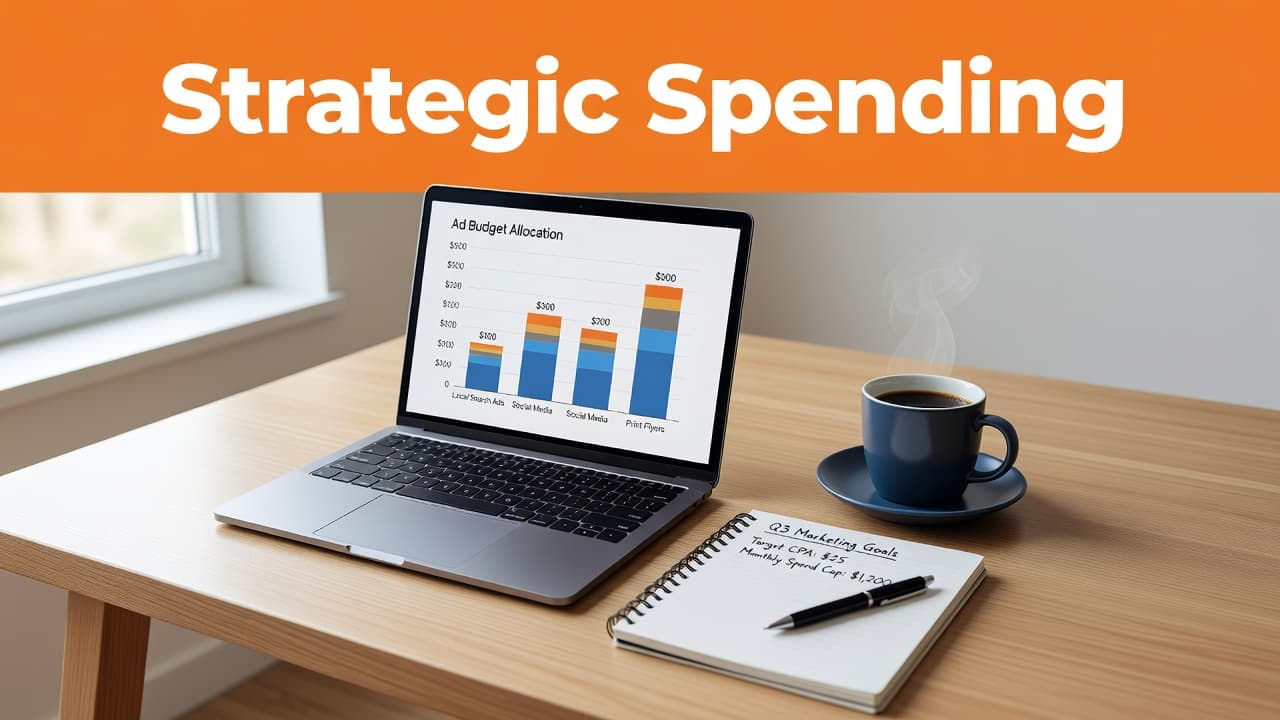
Practical Google Ads Budget Ranges for Local Businesses
Actual costs vary by service, location, season, competition, and the urgency of the search. A personal injury attorney in a major city competes in a different auction than a local cleaner in a smaller Michigan market. To get a realistic estimate for your specific industry, start by using the Google Keyword Planner to research search volume and estimated costs per click in your area.
Still, you need a starting point. A recent 2026 local Google Ads budget guide places many local businesses between $2,000 and $5,000 per month, though smaller, tightly focused campaigns can begin below that range.
Use these figures as ad spend starting points, not promises.
| Business situation | Suggested monthly ad spend | What it can support |
|---|---|---|
| Small test in one service area | $500 to $1,000 | One focused service, limited keyword coverage, modest Search campaigns |
| Established local service business | $1,000 to $2,500 | Consistent Search campaigns and enough lead data to review |
| Competitive contractor or multi-service business | $2,500 to $5,000 | More service coverage, location testing, and steadier Search campaigns lead flow |
| High-value, high-competition legal or home services | $5,000+ | Larger markets, expensive keywords, and aggressive growth goals |
A $500 test can make sense when you have one service, one city, and a narrow audience. An effective small business budget can yield results if it is focused on a single service or area. For example, a pest control company may test a focused campaign for recurring treatment in a defined radius. The limitation is volume. If you only receive a few clicks or two leads, you cannot tell whether the issue is demand, ad copy, the landing page, or simple timing.
For many contractors, medical practices, law firms, and home services companies, $1,500 to $3,000 per month is a more useful initial range. It can provide enough traffic to identify expensive search terms, compare services, and find out whether calls are becoming booked work.
Do not spread a small budget across every service you offer. A roofing company that promotes repairs, replacements, gutters, siding, windows, inspections, and emergency tarping with $1,000 per month will learn very little. Pick the services with the strongest margins, strongest demand, and best close rates.
Let Search Demand and Competition Set the Daily Budget
Your monthly budget becomes a daily budget inside Google Ads. A $1,500 monthly budget is roughly $50 per day. That sounds straightforward until you consider the cost of one click.
In some local markets, a click for "emergency plumber near me" may cost far more than a click for "house cleaning service." If your average cost per click is $20 and your daily budget is $20, Google may only have one opportunity to place your ad that day. That is not enough room to test search terms or recover from an unqualified click.
A useful planning question is: How many clicks can your budget buy each month? Divide your estimated monthly spend by your expected cost per click. Then apply a realistic website conversion rate.
Here is a simple example. A $2,000 budget at a $10 average cost per click buys about 200 clicks. If 10% of visitors convert based on your average conversion rate, that produces around 20 leads. If your team closes 30% of those leads, you may produce six new customers.
The numbers will not hold in every market, but they give you a framework for reviewing results. If you need 20 new jobs monthly, but your budget only supports six, the issue is not a bid adjustment. The plan needs more budget, a better close rate, a higher-value service focus, or a different channel.
Google's automated bidding also needs conversion data. When a campaign receives only a handful of tracked leads each month, automated decisions are based on thin information. Begin with a focused search campaign, accurate conversion tracking, and precise geo-targeting to reach your target audience before expanding into broader campaign types.
Local Services Ads may also fit eligible trades and service categories. Those campaigns operate differently than traditional search ads, often using a pay per lead model rather than the standard cost per click approach. They can be very effective, but you still need to screen leads, dispute invalid ones when appropriate, and track which calls turn into revenue to ensure your daily budget is being spent on the right prospects.
Measure Revenue, Not Only Cost Per Lead
A low cost per lead looks good on a report, but it does not tell the whole story. It matters very little if those leads never answer the phone, fall outside your service area, or are only shopping for the cheapest price.
You must track the full customer journey, including the ad click, phone call or form submission, qualified lead, booked estimate, completed job, and final revenue. Many local campaigns break down here because businesses generate calls but fail to record outcomes, causing them to keep paying for lead types that never produce actual work. To build trust and ensure you are capturing the right signals, make sure your Google Business Profile is fully optimized. Having the Google Verified badge can significantly increase conversion rates by showing potential customers that your business is vetted. Additionally, utilizing ad extensions is a smart way to improve your visibility, as they allow you to display your phone number, location, and service highlights directly in the search results.
Review these key metrics every month:
- Total ad spend and spend by service category
- Calls and form leads, with duplicate and spam leads removed
- Cost per qualified lead, rather than just the cost per inquiry
- Appointment and estimate booking rate
- Close rate and revenue from closed jobs
- Return on Ad Spend (ROAS)
- Missed-call rate and response time
A slow response can quickly undermine a strong ad campaign. When someone searches for an emergency electrician or HVAC repair, they often contact three different companies within minutes. If your phone is not answered promptly, your cost per lead remains the same, but your cost per customer rises sharply.
Review call recordings whenever possible. Look for recurring issues, such as ads attracting work you do not perform, callers located outside your service area, unclear pricing expectations, or staff members who fail to ask for the appointment. These operational findings often matter more than adjusting a single keyword bid.
If your reporting stops at Google Ads conversions, you only see the top half of the funnel. For a clear view of performance, you need lead tracking and Google Ads support that ties your marketing activity to real business outcomes.
Give Your Budget a Fair Test Period
Google Ads requires patience, but you should not use this as an excuse for poor campaign performance. A focused campaign should usually run for at least 60 to 90 days before you make a major decision about scaling, pausing, or rebuilding your strategy.
The first month is often dedicated to setup and optimization. During this time, you should focus on identifying irrelevant searches by adding negative keywords, fixing broken conversion tracking, and improving your Quality Score. The second month typically provides more dependable patterns. By month three, you should have enough data to judge whether qualified leads and revenue support your initial investment.
Avoid changing everything at once. If you raise the budget, rewrite ads, change settings, replace the landing page, and add new services in the same week, you will not know which specific change improved or damaged your results.
Increase spending in steps when results are profitable and your team can handle more leads. A 15% to 25% increase is much easier to evaluate than doubling the budget overnight. If costs rise after an expansion, review your radius targeting, search terms, and location-based targeting settings before assuming the channel has stopped working.
Frequently Asked Questions
How much should a small local business budget for Google Ads each month?
Most local service businesses should start with a monthly budget between $1,000 and $2,500. This range provides enough traffic and lead data to evaluate performance effectively while remaining manageable for smaller companies.
Why does a small budget sometimes fail to produce results?
If your budget is too low, you may not receive enough clicks or leads to establish meaningful data patterns. Without sufficient volume, it becomes nearly impossible to identify which search terms or ads are actually driving profitable work for your business.
How can I tell if my budget is too low for my market?
If your average cost per click is high compared to your daily budget, Google will struggle to place your ads consistently throughout the day. If you are only receiving a handful of clicks each month, you likely need a larger budget or a more focused service strategy to gain enough information to make smart decisions.
How long should I run a campaign before changing my budget?
A campaign requires at least 60 to 90 days of consistent activity before you make significant adjustments. This timeframe allows you to account for initial setup, filter out irrelevant search terms, and collect enough data to measure true return on investment.
Set a Budget You Can Measure and Improve
A workable local business Google Ads budget is large enough to create useful data and controlled enough to protect your cash flow. For many local service businesses, that means starting between $1,000 and $2,500 per month, then adjusting based on qualified leads, booked work, and revenue. You might consider monitoring a weekly budget as well, as this helps prevent overspending while ensuring your campaigns have enough momentum to maintain a steady flow of data.
The right number will vary, but the standard does not change: every dollar should have a clear job. When you know your close rate, lead value, and capacity, your ad budget becomes a strategic business decision rather than a guess. Ultimately, this approach turns your ad spend into a predictable engine for lead generation that supports long term growth.

Related Services



Our Recent Projects
Here's a few of our recent projects. Reach out to us to discuss your project.



What Our Clients Say About Our Work
After working with two other agencies that talked a big game but delivered nothing measurable, I was skeptical about trying another digital marketing firm. What convinced me to give Tim's team a chance was the initial consultation—they asked detailed questions about my business, my competition, and what I'd tried before. No generic pitch, no one-size-fits-all package.
The personalized Action Plan they put together was specific to my industry and location. They showed me exactly what they'd track, how often I'd get reports, and what realistic outcomes looked like in my market. That level of transparency was something I'd never experienced with previous agencies.
Six months in, we're seeing consistent results. Our Google my Business listing went from barely visible to showing up in the top three for our main service terms. Inbound calls have doubled, and more importantly, the quality of those leads is significantly better. We're getting inquiries from people who are ready to move forward, not just tire-kickers.
What I appreciate most is their straightforward communication. When something isn't working as expected, they tell me and adjust the strategy. When results exceed projections, they explain why. Working with a small focused agency means I'm not just another account number—they actually know my business and respond quickly when I have questions.
If you've been burned by agencies before or you're tired of vague monthly reports that don't tie to actual revenue, I'd recommend scheduling a call with them. They've earned my trust by doing exactly what they said they would do.
What impressed me most about working with this agency was their research process. Before they touched anything on our website or started any campaigns, they spent real time analyzing our competitors, mapping out our local market, and identifying exactly where our opportunities were.
Most agencies we talked to wanted to start running ads immediately or promised quick wins without understanding our business. Tim's team did the opposite. They asked detailed questions about our clientele, reviewed our existing marketing materials, and came back with a personalized Action Plan that made complete sense for our industry.
The strategy they devised wasn't some generic template. It addressed specific challenges we face in our geographic area and positioned us against the three main competitors we actually worry about. That level of customization has made all the difference in our results over the past year.
If you're tired of agencies that treat every business the same way, you'll appreciate how they work. They're methodical, they listen, and they build campaigns based on real competitive intelligence rather than guesswork.
What sets this agency apart is the ongoing communication. We're not just handed a strategy in January and left alone until December. Tim schedules monthly calls where we review what's working, what's changed in our market, and how our own business priorities have shifted.
That flexibility has been invaluable. When we opened a second location last spring, they immediately adjusted our local search strategy to cover both service areas. When we decided to focus more on commercial clients versus residential, they pivoted our keyword targeting and ad messaging within days.
The monthly reviews also help us understand where our marketing budget is actually going. They walk through the data in plain language—not jargon—so I can see exactly which campaigns are bringing in leads at what cost. That level of ongoing attention just doesn't happen with larger agencies where you're account number forty-seven.
We've been working together for over two years now, and the strategy today looks quite different from where we started. That evolution happened because they stayed engaged with our business, not just our marketing metrics.

Get In Touch
We'd love to hear from you! Whether you have questions about our services or our maintenance programs reach out to us via the form or any of the other listed methods.
Tim Walker - Owner
Phone: (616) 318-0588
T. Walker Co., LLC
509 Lyncott St.
North Muskegon MI 49445
Business Hours
- Monday - Friday: by appointment
- Saturday - Sunday: Closed
Recent Articles and Posts
If we find it interesting or helpful regarding roofing, construction or other we will share that information here.



T. Walker Co., LLC
(616) 318-0588
509 Lyncott St. North Muskegon MI 49445